Introduction: The Paradox of Loneliness in the Digital Crowd
We inhabit a world more interconnected than any previous generation could have imagined. With a few taps on a glass screen, we can broadcast our thoughts to millions, maintain a continuous textual thread with dozens of acquaintances, and witness the daily minutiae of lives scattered across the globe. We are hyper-connected, tethered to a vast digital nervous system that promises to eradicate the age-old scourges of distance and solitude. Yet, within this unprecedented web of connection, a silent, counterintuitive epidemic is flourishing: profound social isolation and chronic loneliness. This is the central paradox of our age: we have never been more capable of connecting, and yet, we have never felt more alone. The very technologies engineered to bridge gaps between people are, in perverse and often invisible ways, fostering a new kind of disconnect—one that is psychological, emotional, and existential, leaving individuals feeling atomized and adrift in a sea of digital noise.
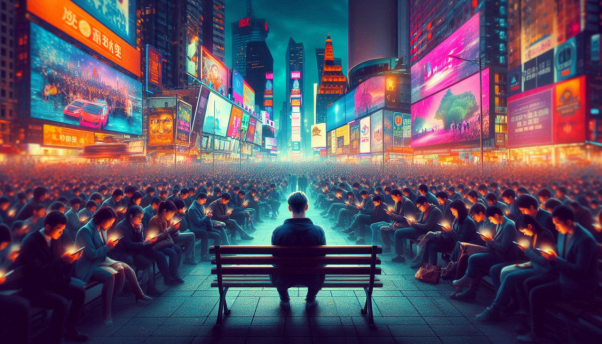
This phenomenon defies simplistic logic. Connection, in its traditional sense, implied a mutual investment of presence, vulnerability, and shared experience. It was a bandwidth-rich exchange of verbal and non-verbal cues—a touch, a tone of voice, a shared silence, the subtle dance of body language in a physical space. The hyper-connection offered by social media platforms, messaging apps, and virtual interactions is, by contrast, often bandwidth-poor and performative. It favors breadth over depth, curation over authenticity, and asynchronous, edited communication over the messy, real-time flow of embodied interaction. We have substituted the deep, complex, and sometimes challenging work of building relationships with the streamlined efficiency of managing social portfolios. The result is a society where one can have hundreds of “friends” or thousands of “followers” while lacking a single confidant to call in a moment of crisis, a state poignantly described as being “alone together.”
The stakes of this crisis are not merely emotional but are matters of public health. Longitudinal studies, such as those by psychologists Julianne Holt-Lunstad and Timothy B. Smith, have demonstrated that chronic loneliness and weak social connection carry a mortality risk comparable to smoking 15 cigarettes a day and exceed the risks associated with obesity and physical inactivity. Loneliness triggers a cascade of physiological stress responses, increasing inflammation, impairing immune function, elevating blood pressure, and disrupting sleep. Psychologically, it is a fertile ground for depression, anxiety, and a corrosive sense of meaninglessness. As we increasingly interface with the world through digital proxies, we risk atrophying the very social muscles—empathy, patience, conflict resolution, deep listening—that are essential for our collective survival and flourishing.
This article will dissect the architecture of this modern isolation across four critical dimensions. First, we will explore The Illusion of Connection, analyzing how digital communication platforms, while offering the mirage of intimacy, often promote shallow, performative exchanges that fail to meet our core psychological needs for belonging and understanding. Second, we will examine The Erosion of Embodied Sociality, detailing how the replacement of face-to-face interaction with screen-mediated communication strips away the essential, non-verbal layers of human connection, impoverishing our social and emotional intelligence. Third, we will investigate The Architecture of Alienation, revealing how the design of social media—its algorithms, metrics, and culture of comparison—actively engineers feelings of inadequacy, FOMO (Fear of Missing Out), and social fragmentation, turning the tool for connection into an engine of estrangement. Finally, we will propose a path toward Cultivating Relational Resilience, outlining concrete strategies for rebuilding authentic, embodied community in a digital age, from intentional digital hygiene and the revival of shared ritual to a philosophical reclamation of vulnerability and presence. The question before us is urgent: can we harness our connective technologies to serve our ancient need for genuine tribe and belonging, or will we allow them to complete the project of our isolation, leaving us connected to everything except each other?
1. The Illusion of Connection: When Breadth Replaces Depth
The digital age has democratized contact, transforming connection from a scarce resource into an abundant, always-available commodity. We can maintain ties with childhood friends, distant relatives, and professional colleagues across continents with minimal effort. Yet, this abundance has fostered a fundamental confusion between contact and connection, between communication and communion. The former is the technical, logistical act of exchanging information; the latter is the psychological, emotional experience of mutual understanding, empathy, and shared reality. The hyper-connected world excels at the former while systematically starving us of the latter, creating a pervasive illusion of social satiety that masks a deep nutritional deficit in our relational lives.
This illusion is powered by the economics of attention that govern digital platforms. In a landscape where user engagement is the primary metric of success, platforms are designed to maximize the quantity, not the quality, of interactions. The “like,” the “share,” the brief comment, the emoji reaction—these are low-friction, high-volume social transactions. They offer a quick hit of social validation (a micro-dopamine release) without the emotional labor or time investment of a meaningful conversation. We are encouraged to broadcast our lives to a broad audience and to consume the curated broadcasts of others, a model that sociologist Sherry Turkle aptly calls “the performance of connection.” In this theater, we become both the actor and the audience, crafting a personal narrative for consumption rather than engaging in the mutual, vulnerable unfolding that characterizes true friendship. A post about a career achievement may garner dozens of congratulatory comments, creating a public façade of support, yet this often substitutes for—and can even discourage—the private, one-on-one phone call or meeting where genuine pride, doubt, and complexity could be shared.
Consequently, our social diets become rich in social snacking but deficient in relational feasting. We scroll through hundreds of data points about people’s lives—their meals, their vacations, their opinions on news events—mistaking this surveillance for intimacy. We may “know” that an acquaintance is on holiday in Greece or has adopted a puppy, but we have no insight into their struggles with anxiety, their grief over a lost parent, or their quiet hopes for the future. This parasocial, one-way intimacy creates a false sense of closeness that evaporates under the slightest pressure. When a real crisis hits—a job loss, a divorce, a illness—the network of “friends” assembled through performative sharing often proves phantom. The support required in such moments is not a “heart” emoji but sustained, embodied presence, practical help, and the willingness to sit with another’s pain, none of which are scalable or compatible with the streamlined logic of feed-based interaction.
Furthermore, the asynchronous, edited nature of digital communication strips away the spontaneity and risk that are the lifeblood of deepening relationships. A text message can be drafted, edited, and perfected before sending; a social media post is a carefully curated exhibit. This removes the stumbling, hesitations, awkward pauses, and unguarded moments in which personality, humor, and vulnerability most authentically emerge. In face-to-face conversation, we react in real-time, our faces betraying micro-expressions of confusion, amusement, or sympathy that guide the interaction. This dance of mutual adjustment is where empathy is exercised and bonds are forged. Digital mediation allows us to present a polished, controlled self, but in doing so, it prevents the “messy middle” where true relational glue is formed. We connect not through our perfected personas, but through the shared recognition of our mutual imperfections, a recognition that is often edited out of the digital self.
The result is a phenomenon of emotional outsourcing. Instead of developing the internal capacity to sit with our own loneliness, boredom, or anxiety, we reflexively reach for the device to seek external validation or distraction. The smartphone becomes a digital pacifier, a shield against the uncomfortable but fertile ground of self-reflection. This constant outward orientation prevents the development of a secure, independent sense of self, which is paradoxically the very foundation upon which healthy, interdependent relationships are built. We seek connection from a place of neediness and fragmentation rather than from a place of wholeness and desire to share, leading to transactional, fragile ties. The illusion of connection, therefore, creates a double isolation: it isolates us from the deep satisfaction of authentic relationships, and it isolates us from the constructive solitude that fosters a resilient self, capable of being truly present with others.
2. The Erosion of Embodied Sociality: The High Cost of Losing the Physical Tribe
Human beings are not merely brains in vats, exchanging pure information. We are embodied, sensory creatures whose social and emotional intelligence is honed through millions of years of evolution in physical proximity. Our most profound connections are forged not solely through words, but through a symphony of non-verbal cues: the warmth of a hug, the reassuring pressure of a hand on a shoulder, the subtle mirroring of body posture that signals rapport, the pheromonal cues we unconsciously detect, and the shared context of a physical environment. The hyper-connected world, by mediating so much of our interaction through screens, performs a radical amputation of this embodied dimension. We are attempting to sustain our social selves on a diet of pure text and image, starving the parts of our neurology and psychology that evolved for rich, multi-sensory engagement. This erosion of embodied sociality is a primary engine of the modern loneliness epidemic.
The science of attachment and neurobiology underscores what we lose. Face-to-face interaction triggers a complex cascade of neurochemical events essential for bonding and well-being. Oxytocin, the so-called “bonding hormone” or “cuddle chemical,” is released through warm, affectionate touch and sustained eye contact. It promotes trust, reduces anxiety, and fosters feelings of generosity and connection. Mirror neurons, systems in the brain that fire both when we perform an action and when we observe another performing it, are crucial for empathy and understanding. They are activated most powerfully by live, observed movement and expression, allowing us to “feel with” others. A pixelated face on a Zoom call or a static profile picture provides a pale, data-poor stimulus for this sophisticated neural machinery. The result is that digital interactions, while cognitively understood, often fail to register at the visceral, emotional level where true belonging is felt. We understand that our friend is sad because they text “I’m having a tough day,” but we do not feel their sadness in the resonant way we would if we saw their slumped shoulders, heard the tremor in their voice, and had the instinctual opportunity to offer a comforting touch.
This sensory impoverishment has dire consequences for the development of social and emotional intelligence, particularly in younger generations whose formative years are increasingly screen-saturated. Emotional intelligence is not an abstract skill; it is learned through practice in the real-time, high-stakes laboratory of embodied interaction. It involves reading a room, detecting a sarcastic tone that contradicts words, noticing when someone’s eyes glaze over in boredom, or sensing the unspoken tension in a group. These skills are acquired through trial, error, and observation in shared physical space. When interaction is migrated to text-based or highly curated visual platforms, these learning opportunities vanish. Misunderstandings proliferate in the absence of tone and body language (leading to the ubiquitous “sorry, that came across wrong over text”), and the nuanced art of navigating complex social dynamics atrophies. We become socially clumsy, more prone to conflict, and less adept at building the kind of nuanced, resilient relationships that buffer against loneliness.
Moreover, embodied presence creates a shared reality that is irreplicable digitally. Sitting across from someone in a café, you share not only words but also the ambient sound, the smell of coffee, the chill from an open door, the sight of the same passerby. This common perceptual field creates a powerful, subconscious sense of “being in the world together.” It grounds the conversation in a tangible, mutual context. Virtual interactions, by contrast, occur in split realities. One person may be in a messy bedroom, another in a noisy kitchen; their attention is divided between the conversation and their own private environment. There is no truly shared “here.” This fragmentation of context makes it harder to achieve the state of joint attention—the foundational human experience of collectively focusing on the same object or idea—which is a cornerstone of collaboration, learning, and deep rapport. Our conversations become disembodied exchanges of information, unmoored from the shared sensory world that gives them texture and meaning.
Finally, the loss of casual, unplanned third spaces—the parks, community centers, churches, pubs, and even shopping malls that are neither home nor work—accelerates isolation. These physical spaces were the breeding grounds for weak ties and accidental community. They were where you might bump into a neighbor, strike up a conversation with a regular at a local diner, or join a pickup basketball game. The digital world, for all its groups and forums, is primarily organized around strong pre-existing interests or identities (e.g., “Fans of 18th-Century Poetry” or “New Parents in Boston”). It lacks the fertile, low-stakes randomness of physical third spaces where diverse, unexpected connections could spark. The privatization of leisure (streaming at home instead of going to a cinema), the decline of civic institutions, and the substitution of digital delivery for physical errands have collectively eroded these infrastructures of casual co-presence. We move from private box (home) to private box (car) to private box (office), interacting with the world through the private box of our smartphone screen. In this architecture, the opportunity for the unplanned, embodied encounter—the seed crystal of so much community—is systematically designed out of daily life, leaving us with a scheduled, intentional, and often lonely social existence.
3. The Architecture of Alienation: How Social Media Design Breeds Estrangement
If the medium of digital communication inherently thins out social interaction, the specific design of social media platforms adds a more active, toxic layer: they are often architected not to foster genuine community, but to maximize engagement metrics, frequently by exploiting psychological vulnerabilities that lead directly to feelings of isolation, inadequacy, and alienation. These platforms are not neutral town squares; they are engineered environments whose business models depend on capturing and monetizing user attention, a goal often best achieved by triggering social comparison, envy, and a perpetual sense of lack. In this sense, the very tools we use to seek connection are built on foundations that manufacture disconnection.
The core engine of this alienation is the culture of comparison and the curated self. Social media feeds are highlight reels, a relentless parade of others’ successes, vacations, romantic milestones, and professional achievements, meticulously filtered and staged. This constant exposure creates a distorted perception of reality, a phenomenon researchers call social comparison theory run amok. We compare our own messy, mundane, behind-the-scenes lives—with their worries, failures, and boring chores—to the polished, finale-ready versions of others’ lives. The inevitable result, for most, is a diminished sense of self-worth and a nagging feeling that everyone else is living a happier, more successful, more connected life. This FOMO (Fear of Missing Out) is not an accidental byproduct but a designed feature. It keeps users scrolling, checking, and posting in a desperate bid to keep up and prove their own social viability. The tragic irony is acute: we log onto these platforms to alleviate feelings of loneliness, only to be presented with overwhelming evidence of the exciting social lives we are ostensibly missing, thereby deepening the very loneliness we sought to cure.
This performance pressure leads to the commodification of identity. The self becomes a brand to be managed, with likes, shares, and follower counts serving as a public stock ticker of social value. This transforms social interaction from an end in itself (enjoying another’s company) into a means to an end (accumulating social capital metrics). Authenticity becomes a strategic calculation: “Will posting this真实 thought or unflattering photo enhance or damage my personal brand?” This internal calculus kills the spontaneous, vulnerable sharing that builds trust. Relationships become transactional, based on mutual utility in building each other’s online personas (e.g., “like-for-like” exchanges). The profound alienation here is from one’s own authentic experience. We become detached observers of our own lives, constantly asking, “Is this moment post-worthy?” rather than simply living it. The French philosopher Guy Debord’s concept of the “spectacle”—where life is replaced by its representation—finds its ultimate expression in the Instagram feed, where we live less and document more, estranged from our own unmediated existence.
Underpinning this culture is the algorithmic curation of reality. Platforms use opaque algorithms to decide what content we see, prioritizing material that triggers strong emotional reactions—outrage, envy, awe—because such content keeps us engaged. These algorithms often create filter bubbles or echo chambers, surrounding us with content and worldviews that reinforce our pre-existing beliefs and identities. While this may feel comfortable, it is profoundly socially fragmenting. It erodes the common ground of shared facts and civic discourse, making it harder to empathize with or even understand those outside our digital tribe. The public square is shattered into a million private, self-reinforcing rooms. Furthermore, algorithms frequently prioritize content from loose acquaintances or influencers over updates from close friends and family, because novel, distant content is more likely to capture curiosity. This subtly teaches us to value the broad, performative network over the deep, intimate one, redirecting our scarce social energy towards maintaining weak ties at the expense of strong ones.
Finally, these platforms facilitate the substitution of passive consumption for active connection. The default mode of engagement is scrolling, a passive act of consumption that researcher Sherry Turkle contrasts with the active work of conversation. We “keep up” with friends by watching their stories and liking their posts, mistaking this surveillance for relationship maintenance. This creates a dangerous illusion: we feel connected to people because we are informed about them, so we invest less effort in the active, reciprocal work of reaching out, making a phone call, or organizing a meet-up. The relationship becomes parasocial, maintained by our one-sided consumption of their broadcast. The platforms, benefiting from our passive scrolling time, have no incentive to encourage the active, time-consuming, off-platform interactions that actually sustain friendship. Thus, the architecture systematically encourages the very behaviors—passive consumption, performance, comparison—that hollow out relationships, leaving us with a social network that feels vast and active but is, in terms of true relational sustenance, a desert.
4. Cultivating Relational Resilience: Rebuilding Community in a Digital Age
Confronting the crisis of isolation in a hyper-connected world requires moving beyond critique to proactive cultivation. It demands a deliberate, counter-cultural effort to rebuild the muscles of authentic connection and the infrastructures of community that our digital lifestyles have allowed to atrophy. This project of cultivating relational resilience is not about rejecting technology outright, but about subordinating it to human priorities, reclaiming agency over our social lives, and reinvesting in the slow, embodied, and vulnerable work of building belonging. It is a practice that operates at the level of individual habit, communal design, and cultural value.
The foundational step is Intentional Digital Hygiene for Social Health. Just as we manage our diets, we must consciously manage our social technology use with relational well-being as the goal. This begins with a ruthless audit: which platforms and uses leave you feeling connected and energized, and which leave you feeling lonely, anxious, or inadequate? Based on this, one can implement strategies like designated tech-free times and zones—most critically, during meals, the first and last hours of the day, and in the bedroom. This protects sacred spaces for embodied interaction (with family or housemates) and for solitude. Radically curating notification settings is essential; turning off social media notifications breaks the compulsive “slot machine” cycle and returns control of your attention to you. Perhaps most powerfully, consider demoting social media from a primary to a secondary tool. Use it for logistical planning (“Let’s meet at this park Saturday”) or sharing specific news with distant relatives, but explicitly reject it as your primary mode of relationship maintenance. Make a rule: if you see something meaningful from a friend online, let it be a prompt to switch to a rich medium—send a voice note, make a phone call, or schedule a visit. This simple act of channel-switching can rebuild relational depth.
Beyond personal habits, we must actively Revive Embodied Ritual and Shared Endeavor. Relational resilience is built through repeated, shared action in physical space. This requires proactively creating and protecting third spaces in our lives. Join a recurring, in-person group that is not about performance: a book club, a community garden, a choir, a hiking group, a volunteer organization, a religious community, or a crafts workshop. The activity itself provides a shared focus that eases the pressure of pure socializing, allowing bonds to form organically. Prioritize rituals of co-presence: weekly family dinners without devices, a regular coffee or walk with a friend, a standing game night. The regularity is key; it builds a rhythm of connection that withstands the busyness of modern life. Furthermore, embrace low-stakes, unoptimized time together. The pressure for every gathering to be an “event” or a perfect “experience” (often documented for social media) is exhausting and alienating. Instead, reclaim the value of “parallel play” for adults: cooking a meal together in comfortable silence, reading in the same room, working on separate projects at the same café. These moments of shared, unforced presence rebuild the fabric of casual belonging that digital life strips away.
At the psychological level, we must practice The Courage of Vulnerability and Deep Listening. The antidote to performative, curated connection is intentional, unvarnished authenticity. This involves taking relational risks: sharing a doubt or a failure with a friend instead of just a victory; asking a “heavy” question beyond “How’s work?”; admitting “I’ve been feeling lonely” or “I’m struggling with this.” Brené Brown’s research on vulnerability powerfully demonstrates that it is the cornerstone of true belonging. Simultaneously, we must cultivate the discipline of deep listening—listening to understand, not to reply or to judge. In conversation, this means putting the phone away, maintaining eye contact, and resisting the urge to immediately reframe the other’s experience through your own. It means asking follow-up questions and tolerating silences. This quality of attention is a profound gift in a distracted world and is the bedrock of feeling truly seen and known. We must also foster digital empathy, remembering the human on the other side of the screen, and choosing richer channels (a call, a video chat) for complex or emotionally sensitive conversations that text is doomed to impoverish.
Finally, we must engage in Community Architecture and Cultural Advocacy. Relational resilience cannot be achieved by individuals alone; it requires supportive environments. We can advocate for and participate in local efforts to create vibrant public spaces—parks, plazas, community centers—that encourage mingling. Employers can be encouraged to design workplaces that foster real collaboration and social connection rather than just digital efficiency, and to respect boundaries that protect employees’ time for private relational life. On a cultural level, we need new narratives that celebrate depth, vulnerability, and embodied presence over breadth, curated perfection, and digital busyness. We must challenge the notion that a busy social calendar online equates to a rich relational life offline. This is a long-term project of re-imagining what a “good life” looks like in the 21st century, one that places authentic, reciprocal belonging at its center.
Cultivating relational resilience is slow, often awkward work. It is less convenient than sending a text, less glamorous than a curated post, and requires confronting the very social anxieties that drive us to digital substitutes in the first place. But the reward is the opposite of isolation: it is the profound, life-sustaining sense of being embedded in a web of mutual care and understanding. It is the feeling of being home in the presence of others. In a world expertly engineered to sell us the illusion of connection, the real thing remains a hands-on, hearts-open, analog practice. It is the practice of putting down the device, looking up, and reaching out—not just to broadcast, but to truly build, one vulnerable, present moment at a time.
Sources
Achterbergh, L., Pitman, A., Birken, M., Pearce, E., Sno, H., & Johnson, S. (2020). The experience of loneliness among young people with depression: A qualitative meta-synthesis of the literature. BMC Psychiatry, *20*(1), 415.
Baumeister, R. F., & Leary, M. R. (1995). The need to belong: Desire for interpersonal attachments as a fundamental human motivation. Psychological Bulletin, *117*(3), 497–529.
Brown, B. (2010). The gifts of imperfection: Let go of who you think you’re supposed to be and embrace who you are. Hazelden Publishing.
Brown, B. (2012). Daring greatly: How the courage to be vulnerable transforms the way we live, love, parent, and lead. Gotham Books.
Cacioppo, J. T., & Patrick, W. (2008). Loneliness: Human nature and the need for social connection. W.W. Norton & Company.
Clark, J. L., Algoe, S. B., & Green, M. C. (2018). Social network sites and well-being: The role of social connection. Current Directions in Psychological Science, *27*(1), 32–37.
Debord, G. (1967). The society of the spectacle. Buchet-Chastel.
Dunbar, R. I. M. (2010). How many friends does one person need? Dunbar’s number and other evolutionary quirks. Harvard University Press.
Holt-Lunstad, J., Smith, T. B., Baker, M., Harris, T., & Stephenson, D. (2015). Loneliness and social isolation as risk factors for mortality: A meta-analytic review. Perspectives on Psychological Science, *10*(2), 227–237.
Kross, E., Verduyn, P., Demiralp, E., Park, J., Lee, D. S., Lin, N., Shablack, H., Jonides, J., & Ybarra, O. (2013). Facebook use predicts declines in subjective well-being in young adults. PLOS ONE, *8*(8), e69841.
McPherson, M., Smith-Lovin, L., & Brashears, M. E. (2006). Social isolation in America: Changes in core discussion networks over two decades. American Sociological Review, *71*(3), 353–375.
Oldenburg, R. (1989). The great good place: Cafés, coffee shops, bookstores, bars, hair salons, and other hangouts at the heart of a community. Marlowe & Company.
Pariser, E. (2011). The filter bubble: How the new personalized web is changing what we read and how we think. Penguin Press.
Putnam, R. D. (2000). Bowling alone: The collapse and revival of American community. Simon & Schuster.
Sherman, L. E., Michikyan, M., & Greenfield, P. M. (2013). The effects of text, audio, video, and in-person communication on bonding between friends. Cyberpsychology: Journal of Psychosocial Research on Cyberspace, *7*(3).
Twenge, J. M. (2017). iGen: Why today’s super-connected kids are growing up less rebellious, more tolerant, less happy—and completely unprepared for adulthood—and what that means for the rest of us. Atria Books.
Turkle, S. (2011). Alone together: Why we expect more from technology and less from each other. Basic Books.
Turkle, S. (2015). Reclaiming conversation: The power of talk in a digital age. Penguin Press.
Valkenburg, P. M., & Peter, J. (2009). Social consequences of the Internet for adolescents: A decade of research. Current Directions in Psychological Science, *18*(1), 1–5.
Vorderer, P., Krömer, N., & Schneider, F. M. (2016). Permanently online – Permanently connected: Explorations into university students’ use of social media and mobile smart devices. Computers in Human Behavior, *63*, 694–703.
Waytz, A., & Gray, K. (2018). Does online technology make us more or less sociable? A preliminary review and call for research. Perspectives on Psychological Science, *13*(4), 473–491.
Williams, K. D. (2007). Ostracism. Annual Review of Psychology, *58*, 425–452.
HISTORY
Current Version
Dec, 03, 2025
Written By
BARIRA MEHMOOD